The Sainte-Chapelle (French pronunciation: [sɛ̃t ʃapɛl], Holy Chapel) is a royal chapel in the Gothic style, within the medieval Palais de la Cité, the residence of the Kings of France until the 14th century, on the Île de la Cité in the heart of Paris, France.
The five things that I see
-very tall roofs=très hauts toits
-tall stained glass=tall vitraux
-a tall pointy tower=un grand tour pointues
- chandeliers = chandeliers
-gold painted walls=or peint les murs
The Palace of Versailles, or simply Versailles is a royalchâteau in Versailles in the Île-de-France region of France. It is also known as the Château de Versailles. When the château was built, Versailles was a country village; today, however, it is a wealthy suburb ofParis, some 20 kilometres (12 miles) southwest of the French capital. The court of Versailles was the centre of political power in France from 1682, whenLouis XIVmoved from Paris, until theroyal familywas forced to return to the capital in October 1789 after the beginning of theFrench Revolution. Versailles is therefore famous not only as a building, but as a symbol of the system ofabsolute monarchyof theAncien Régime.
The five things that I see -beautiful gardens =de beaux jardins - amazing chandeliers inside= lustres étonnants à l'intérieur - a marble courtyard= une cour de marbre - a huge long -hall= un énorme long couloir
The monument stands 50 metres (164 ft) in height, 45 m (148 ft) wide and 22 m (72 ft) deep. The large vault is 29.19 m (95.8 ft) high and 14.62 m (48.0 ft) wide. The small vault is 18.68 m (61.3 ft) high and 8.44 m (27.7 ft) wide. Its design was inspired by the Roman Arch of Titus. The Arc de Triomphe is built on such a large scale that, three weeks after the Paris victory parade in 1919 (marking the end of hostilities in World War I), Charles Godefroy flew his Nieuportbiplane through it, with the event captured on newsreel
The Jardin du Luxembourg, or the Luxembourg Garden, located in the 6th arrondissement of Paris, was created beginning in 1612 by Marie de' Medici, the widow of King Henry IV of France, for a new residence she constructed, the Luxembourg Palace. The garden today is owned by the French Senate, which meets in the Palace. It covers 23 hectares and is known for its lawns, tree-lined promenades, flowerbeds, the model sailboats on its circular basin, and for the picturesque Medici Fountain, built in 1620.
the five things that I can see
-a line of trees=Une ligne d'arbres
- a large metal fence=Une grande clôture métallique
- lots of grass=beaucoup d'herbe
-statues=statues
- huge flower pots= d'énormes pots de fleur
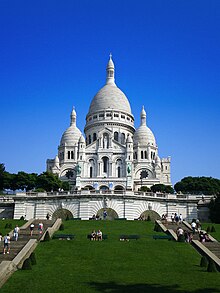
The Basilica of the Sacred Heart of Paris, commonly known as Sacré-Cœur Basilica and often simply Sacré-Cœur(French: Basilique du Sacré-Cœur, pronounced [sakʁe kœʁ]), is a Roman Catholic church and minor basilica, dedicated to the Sacred Heart of Jesus, in Paris, France. A popular landmark, the basilica is located at the summit of the butteMontmartre, the highest point in the city. Sacré-Cœur is a double monument, political and cultural, both a national penance for the defeat of France in the 1871 Franco-Prussian War and the socialist Paris Commune of 1871[1] crowning its most rebellious neighborhood, and an embodiment of conservative moral order, publicly dedicated to the Sacred Heart of Jesus, which was an increasingly popular vision of a loving and sympathetic Christ .
The five things that I see
- green grass=Herbe verte
-two sets of stairs=Deux séries de marches
-three tall towers=Trois hautes tours
- a white cross=Une croix blanche
-a Jesus statue=Une statue de Jésus
Five things that I see
-medieval architecture =Architecture médiévale
-the 4th arr= le 4eme arr.
-glass windows=Fenêtres de verre
-gargoilles
-Île de la Cité